sabato 10 maggio 2014

The Saddle and the Horse’s Tail Cauda Equina Syndrome

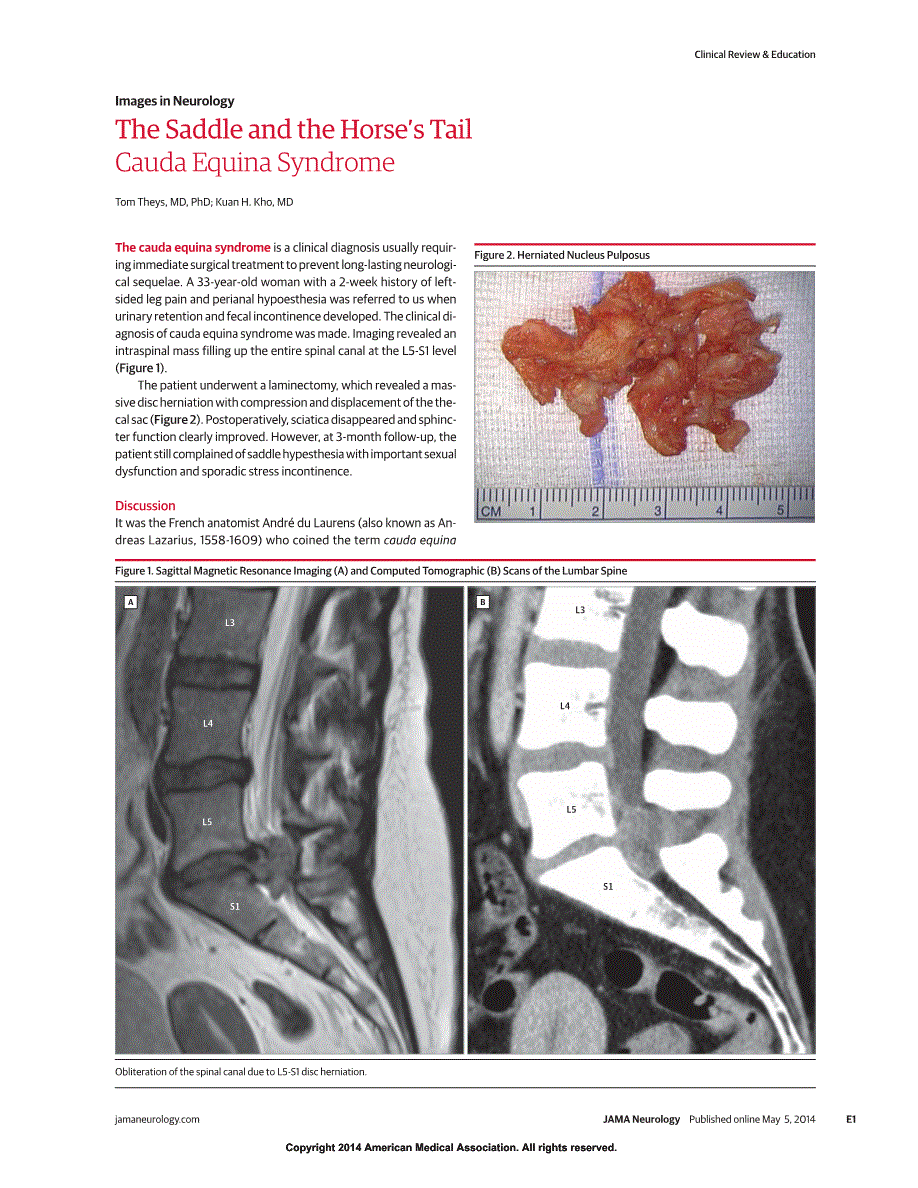
The cauda equina syndrome is a clinical diagnosis usually requiring immediate surgical treatment to prevent long-lasting neurological sequelae. A 33-year-old woman with a 2-week history of left-sided leg pain and perianal hypoesthesia was referred to us when urinary retention and fecal incontinence developed. The clinical diagnosis of cauda equina syndrome was made. Imaging revealed an intraspinal mass filling up the entire spinal canal at the L5-S1 level 

JAMA Neurology 2014

Clinical Predictors of Severe Cerebral Amyloid Angiopathy and Influence of APOE Genotype in Persons With Pathologically Verified Alzheimer Disease

Importance  Although cerebral amyloid angiopathy (CAA) has important clinical implications, our understanding of it and ability to diagnose it are limited.
Objective  To determine pathological correlates and clinical factors identifiable during life that predict the presence of severe CAA in persons with pathologically confirmed Alzheimer disease (AD).
Design, Setting, and Participants  We compared demographic and clinical variables at the earliest visit during life at which participants were found to have cognitive impairment and compared pathological variables between persons ultimately found to have no or severe CAA at autopsy using logistic regression. Analyses were repeated separately for carriers and noncarriers of the APOE ε4 allele. Data were obtained from the Uniform Data Set, which comprises longitudinal clinical assessments performed in the Alzheimer’s Disease Centers funded by the National Institute on Aging. Participants included 193 persons with AD and severe CAA and 232 persons with AD and no CAA. All participants had cognitive impairment and met National Institute on Aging–Reagan Institute neuropathological criteria for AD.
Main Outcomes and Measures  Prevalence of demographic characteristics and the APOE ε4 allele and odds ratios (ORs) of clinical variables for the prediction of severe CAA.
Results  Persons with severe CAA compared with those without CAA were more likely to carry anAPOE ε4 allele (64.9% vs 42.8%, respectively; P < .001), to be Hispanic (6.8% vs 1.3%, respectively;P = .003), to have had a transient ischemic attack (12.5% vs 6.1%, respectively; OR = 2.1; 95% CI, 1.0-4.4), and to have lower degrees of diffuse amyloid plaque pathology (mean [SD] Consortium to Establish a Registry for Alzheimer’s Disease score, 1.2 [0.5] vs 1.4 [0.8], respectively; P = .01). Those with CAA compared with those without CAA more commonly had intracerebral hemorrhage (9.3% vs 3.5%, respectively; P = .01), cortical microinfarcts (20.7% vs 12.9%, respectively; P = .03), and subcortical leukoencephalopathy (20.5% vs 12.1%, respectively; P = .02). Noncarriers of the APOEε4 allele with severe CAA compared with those without CAA had a higher prevalence of stroke (11.1% vs 3.9%, respectively; OR = 3.8; 95% CI, 1.0-14.6) and hypercholesterolemia (50.0% vs 32.7%, respectively; OR = 2.3; 95% CI, 1.1-4.7).
Conclusions and Relevance  Being Hispanic and having had a transient ischemic attack–like episode were predictors of CAA in persons with AD. Less diffuse parenchymal amyloid pathology in persons with severe CAA suggests a difference in β-amyloid trafficking.

JAMA Neurology 2014
Painful and painless channelopathies

The discovery of genetic variants that substantially alter an individual's perception of pain has led to a step-change in our understanding of molecular events underlying the detection and transmission of noxious stimuli by the peripheral nervous system. For example, the voltage-gated sodium ion channel Nav1.7 is expressed selectively in sensory and autonomic neurons; inactivating mutations in SCN9A, which encodes Nav1.7, result in congenital insensitivity to pain, whereas gain-of-function mutations in this gene produce distinct pain syndromes such as inherited erythromelalgia, paroxysmal extreme pain disorder, and small-fibre neuropathy. Heterozygous mutations in TRPA1, which encodes the transient receptor potential cation channel, can cause familial episodic pain syndromes, and variants of genes coding for the voltage-gated sodium channels Nav1.8 (SCN10A) and Nav1.9 (SCN11A) lead to small-fibre neuropathy and congenital insensitivity to pain, respectively. Furthermore, other genetic polymorphisms have been identified that contribute to risk or severity of more complex pain phenotypes. Novel models of sensory disorders are in development—eg, using human sensory neurons differentiated from human induced pluripotent stem cells. Understanding rare heritable pain disorders not only improves diagnosis and treatment of patients but may also reveal new targets for analgesic drug development.

Lancet Neurology 2014

PMP22 messenger RNA levels in skin biopsies: testing the effectiveness of a Charcot–Marie–Tooth 1A biomarker

Charcot–Marie–Tooth disease type 1A (CMT1A) is associated with increased gene dosage for PMP22. Therapeutic approaches are currently aiming at correcting PMP22 over-expression. It is unknown whetherPMP22 can be used as a biological marker of disease progression and therapy efficacy. We performed quantitative real-time polymerase chain reaction on skin biopsies of 45 patients with CMT1A, obtained at study entry and after 24-months of treatment either with ascorbic acid or placebo. Data of a subgroup of patients were also compared with matched healthy subjects. Finally, we analysed PMP22 messenger RNA levels in sural nerve biopsies. We did not find significant differences in the levels of any known PMP22 transcripts in treated or untreated patients with CMT1A, thus confirming that ascorbic acid does not impact on the molecular features of CMT1A. Most importantly, we did not observe any correlation between PMP22 messenger RNA levels and the different clinical and electrophysiological outcome measures, underscoring the weakness of PMP22 to mirror the phenotypic variability of patients with CMT1A. We did not find increased PMP22 messenger RNA levels in skin and sural nerve biopsies of patients with CMT1A compared with relative controls. In conclusion, this study shows that ascorbic acid does not impact on PMP22 transcriptional regulation and PMP22 is not a suitable biomarker for CMT1A.
Brain 2014

Gerstmann-Straüssler-Scheinker disease

Objective: To describe a unique case of Gerstmann-Straüssler-Scheinker (GSS) disease caused by a novel prion protein (PRNP) gene mutation and associated with strongly positive voltage-gated potassium channel (VGKC)-complex antibodies (Abs).
Methods: Clinical data were gathered from retrospective review of the case notes. Postmortem neuropathologic examination was performed, and DNA was extracted from frozen brain tissue for full sequence analysis of the PRNPgene.
Results: The patient was diagnosed in life with VGKC-complex Ab–associated encephalitis based on strongly positive VGKC-complex Ab titers but no detectable LGI1 or CASPR2 Abs. He died despite 1 year of aggressive immunosuppressive treatment. The neuropathologic diagnosis was GSS disease, and a novel mutation, P84S, in thePRNP gene was found.
Conclusion: VGKC-complex Abs are described in an increasingly broad range of clinical syndromes, including progressive encephalopathies, and may be amenable to treatment with immunosuppression. However, the failure to respond to aggressive immunotherapy warns against VGKC-complex Abs being pathogenic, and their presence does not preclude the possibility of prion disease.
Neurology 2014

Asymptomatic HIV-associated neurocognitive impairment increases risk for symptomatic decline

Objective: While HIV-associated neurocognitive disorders (HAND) remain prevalent despite combination antiretroviral therapy (CART), the clinical relevance of asymptomatic neurocognitive impairment (ANI), the most common HAND diagnosis, remains unclear. We investigated whether HIV-infected persons with ANI were more likely than those who were neurocognitively normal (NCN) to experience a decline in everyday functioning (symptomatic decline).
Methods: A total of 347 human participants from the CNS HIV Anti-Retroviral Therapy Effects Research (CHARTER) cohort were NCN (n = 226) or had ANI (n = 121) at baseline. Neurocognitive assessments occurred approximately every 6 months, with median (interquartile range) follow-up of 45.2 (28.7–63.7) months. Symptomatic decline was based on self-report (SR) or objective, performance-based (PB) problems in everyday functioning. Proportional hazards modeling was used to generate risk ratios for progression to symptomatic HAND after adjusting for baseline and time-dependent covariates, including CD4+ T-lymphocyte count (CD4), virologic suppression, CART, and mood.
Results: The ANI group had a shorter time to symptomatic HAND than the NCN after adjusting for baseline predictors: adjusted risk ratios for symptomatic HAND were 2.0 (confidence interval [CI] 1.1–3.6; p = 0.02) for SR, 5.8 (CI 3.2–10.7; p < 0.0001) for PB, and 3.2 (CI 2.0–5.0; p < 0.0001) for either SR or PB. Current CD4 and depression were significant time-dependent covariates, but antiretroviral regimen, virologic suppression, and substance abuse or dependence were not.
Conclusions: This longitudinal study demonstrates that ANI conveys a 2-fold to 6-fold increase in risk for earlier development of symptomatic HAND, supporting the prognostic value of the ANI diagnosis in clinical settings. Identifying those at highest risk for symptomatic decline may offer an opportunity to modify treatment to delay progression.

Neurology 2014

Partial deletion of AFG3L2 causing spinocerebellar ataxia type 28

Objective: To identify the genetic cause of autosomal dominant spinocerebellar ataxia type 28 (SCA28) with ptosis in 2 Belgian families without AFG3L2 point mutations and further extend the clinical spectrum of SCA28 through the study of a brain autopsy, advanced MRI, and cell-based functional assays exploring the underlying disease mechanism.
Methods: Two large families were clinically examined in detail. Linkage analysis and multiplex amplicon quantification were performed. A brain autopsy was obtained. Brain MRI with voxel-based morphometry and diffusion tensor imaging was performed. RNA and Western blot analysis and blue native–polyacrylamide gel electrophoresis experiments were performed.
Results: MRI analysis demonstrated a significant cerebellar atrophy, as well as white matter degeneration in the cerebellar peduncles, corticospinal tracts, corpus callosum, and cingulum. A brain autopsy showed severe atrophy of the upper part of the cerebellar hemisphere. Ubiquitin and p62 immunoreactive intranuclear inclusions were found in cerebral and cerebellar cortical neurons, in neurons of the hippocampus, and in pontine and medullary nuclei. An identical heterozygous partial deletion of exons 14 to 16 of the AFG3L2 gene was found in both families. Additional functional assays in patient-derived cell lines revealed haploinsufficiency as the underlying disease mechanism.
Conclusions: Our study expands the phenotypic characterization of SCA28 by means of brain pathology and diffusion tensor imaging/voxel-based morphometry MRIs. The identification of a partial AFG3L2 deletion and the subsequent functional studies reveal loss of function as the most likely disease mechanism. Specific testing for deletions in AFG3L2 is warranted because these escape standard sequencing.

Neurology 2014